
Nagaland is one of the the northeastern Indian states that is full of vibrant colors, vibrant traditions and breathtaking scenery. Here’s a peek into Nagaland’s captivating landscape:
Stunning Landscapes:
- Majestic Mountains: The terrain of Nagaland is mostly mountainous and hilly. is located in the Eastern Himalaya range runs through much the Naga territory. Of them, Saramati stands highest at an altitude of 3840m.
- Lush valleys It is home to numerous valleys that make trekking possible. The most famous of them are the Dzukou Valley marked with rhododendrons flowers.
- Dense Forests: Nagaland is a very abundant forest cover. This forest comprises evergreen semi-evergreen and wet, moist pine and deciduous forests, and all of them support various kinds of wild life.
Vibrant Cultures:
- Different Tribes Total: twelve tribes have recognized as part of the Nagaland Indian state, where sixteen major tribes live and each has distinct language, culture and customs.
- Colourful Festivals: The state bursts with vibrant colors during festivals that are well-known throughout the year, including the Hornbill festival, which showcases the rich cultural heritage that is the Nagas.
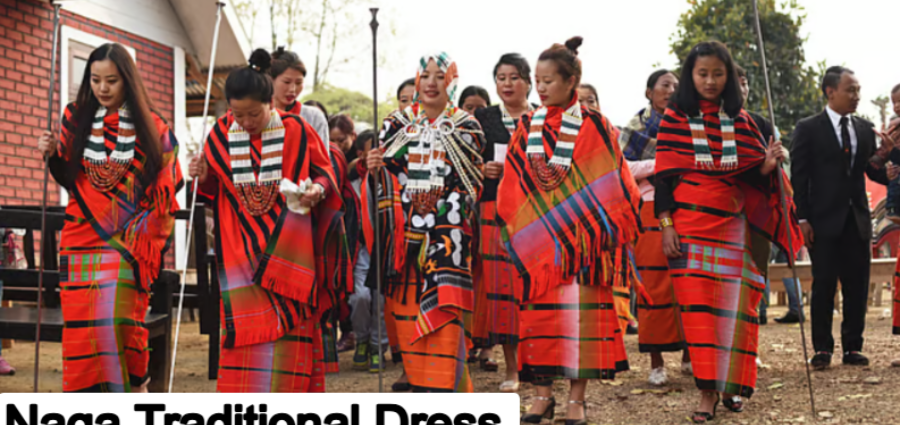
Traditional attire that is worn by the Naga tribe from Northeast India: vivid and stunning, illustrating the splendor of the exclusivity of tribes within this area. Naga traditional dress for both female and male is different in each Naga Tribe to the next however their attire is striking due to its colors of embroidery, lace and other accessories.
Traditional Dress for Women
Naga the traditional dress for women is usually feminine and dresses elegantly. The most popular kind of clothes is the ‘Mekhela’, which is basically a gorgeously colored and designed skirt that wraps around and paired with ‘Rih’ that is a blouse or a particular gown-style shawl. They are typically made of fibre and are often made of silk or cotton, and are embellished with designs and patterns that are inspired by nature or mythology. Plain or embellished Rih can even be stitched onto belts, clothes or bags as accessories for the nation, such as a the bangle, earring, necklace or bangle, for example.
Another popular traditional and colorful dress to wear for ladies is Angami which is a long-sleeved dress made from silk or cotton. The Angami is a kind of coat, is paired with a Mechala, which is a shawl and is worn over shoulders. The Angami wrap is usually adorned with beads or embroidery and is often complemented by traditional accessories like earrings, necklaces and Bangles.
Traditional Dress for Men
Naga traditional dress for males is typically more simple and less flashy in comparison to women’s attire among the Nagas. The most frequently worn piece of clothing is the Alungstu which is a blanket that has a sleeves cut from silks or cotton. The Alungstu is often worn alongside the Kilt that is a short skirt made of wool or cotton material. It can be embellished with patterns and designs printed on the fabric. It is typically paired with accessories that like necklaces, headgear and bracelets.
A different traditional attire worn by men in those in the Naga are the Shawl It is a cloth with a length of several yards length and carried on the shoulders. The Shawl can be made from wool or cotton and features patterns and designs on the two ends. The Shawl is typically worn with necklaces, head gear and Bangles.
Apart from the traditional textiles, Naga people also used accessories such as necklaces, headgear or earrings, bracelets, anklets. These accessories for hosiery are generally constructed from gold, silver or other types of metal, and can be designed in intricate ways.
In naming the traditional clothing worn for the Naga people as the traditional attires I am still of the opinion that they are a vital part to Naga culture. Naga culture. They see it as a representation of what they stand for, and something to take pride in. They Naga people are involved in making sure that their traditional attire is still worn and will continue to be worn by the generations to follow.